

Choosing the right words for your website is like choosing the right bait for fishing. If you use the wrong kind, you might go home with an empty bucket. In the world of search engines, we call these words “keywords.”
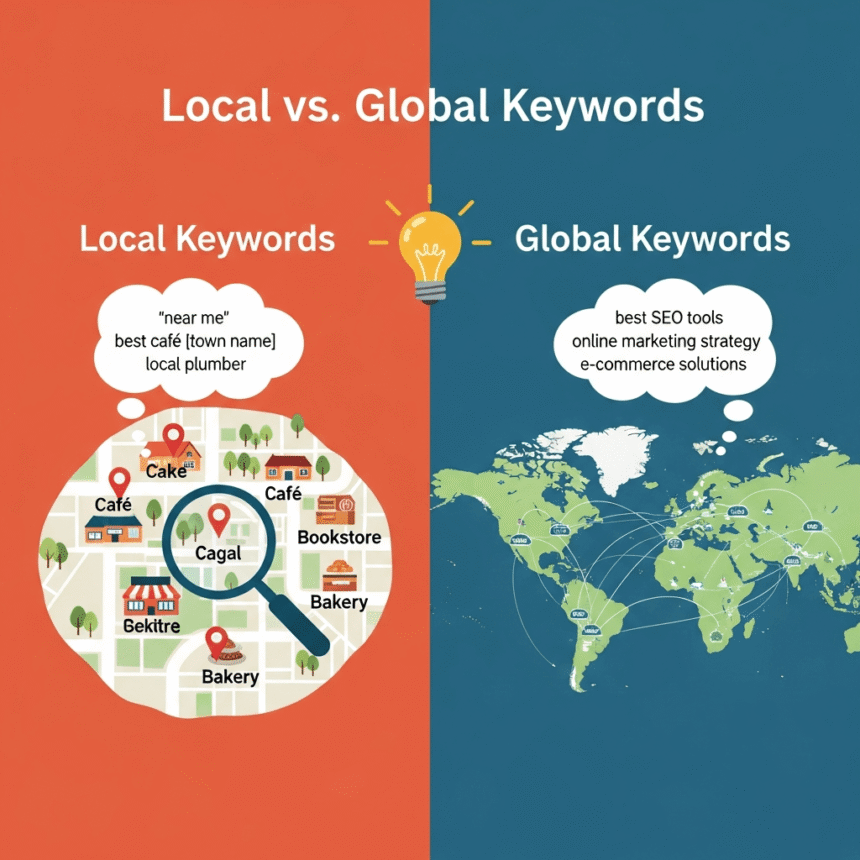
To grow your website, you need to understand the difference between Local Keywords and Global Keywords. Both are useful, but they serve very different purposes.
What are Global Keywords?
Global keywords are broad terms that people search for regardless of where they are in the world. They usually focus on general information, products, or services that aren’t tied to a specific place.
Example: “How to bake a chocolate cake” or “Best smartphone 2026.”
The Reach: You can attract visitors from New York, London, or Tokyo all at the same time.
The Challenge: Competition is very high. You are competing against every other website on the planet for that top spot.
What are Local Keywords?
Local keywords are phrases that include a specific location or imply that the user is looking for something nearby. They are used by people who want to find a service or product in their physical area.
Example: “Best pizza in Chicago” or “Plumbers near me.”
The Reach: You are targeting a specific neighborhood, city, or region.
The Benefit: Competition is much lower. It is easier to show up on the first page of search results when you are only competing with businesses in your town.
Which One Should You Choose?
The answer depends on what your website does.
Use Global Keywords if:
You sell digital products like e-books or software.
You run a news site or a hobby blog.
Your goal is to get as much traffic as possible from anywhere.
Use Local Keywords if:
You have a physical shop or office.
You provide a service that requires you to be there in person, like roofing or hair styling.
You want visitors who are ready to buy something right now in their area.
Finding the Right Balance
Most successful websites use a mix of both. You might use global keywords to build your reputation and show that you are an expert. Then, you use local keywords to actually bring customers through your front door.
For example, a gym owner might write a global blog post about “The Benefits of Weightlifting” to get people interested. Then, they would optimize their main page for “Gym in Downtown Miami” to make sure local residents can find them.
Understanding your audience is the first step to winning the search engine game. By picking the right keywords, you make it easier for the right people to find you.
Would you like me to generate a list of specific local and global keywords for your specific business niche?