
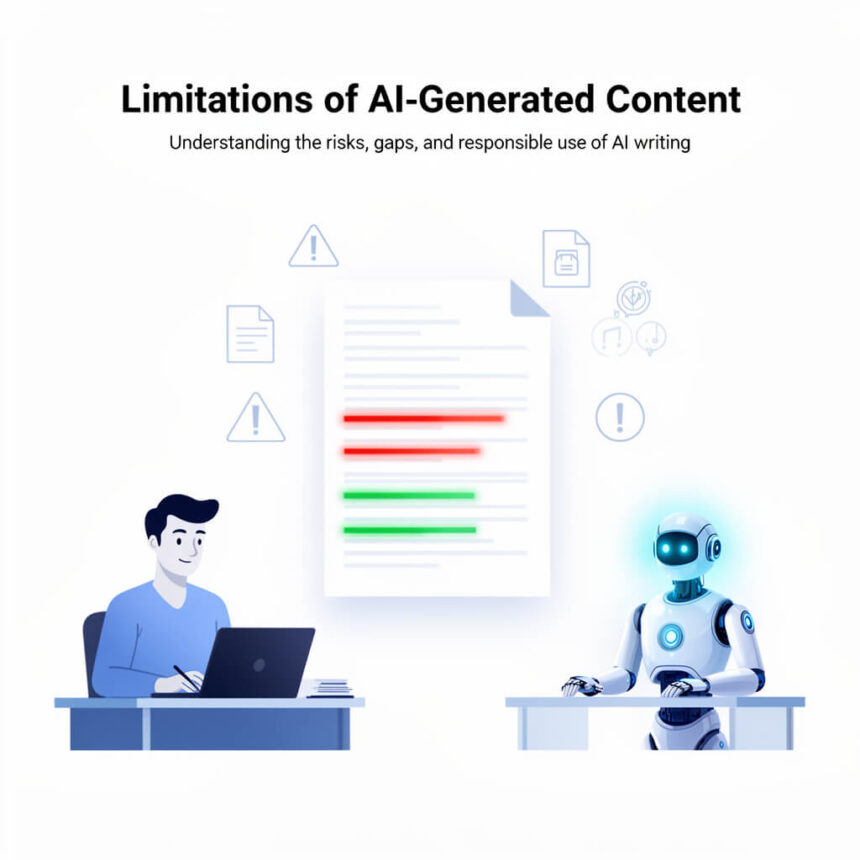

Artificial Intelligence has changed the way we create content. It can write articles in seconds, help with research, and even suggest ideas for social media. However, while it is a powerful tool, it is not perfect. If you rely only on AI to write your blog posts or business reports, you might face some serious issues.
Understanding these boundaries is important for anyone who wants to maintain a high quality of work. Here are the primary limitations of AI-generated content.
Lack of Real Human Experience
The biggest gap in AI writing is the absence of a personal touch. AI does not have a life. It hasn’t traveled to a new city, felt the frustration of a broken tool, or celebrated a business success.
When humans write, they often share stories or small details from their own lives. These personal anecdotes build trust with the reader. Because AI only predicts the next word based on patterns, it cannot offer genuine “first-hand” advice. This makes the content feel robotic or “hollow” to a smart audience.
Problems with Accuracy and Hallucinations
AI models do not actually “know” facts. They are trained on huge amounts of data to understand how language works. Sometimes, the AI will state a fact that sounds very confident but is completely wrong. This is often called a “hallucination.”
If you are writing about medical advice, legal issues, or financial tips, these mistakes can be dangerous. You must always double-check every date, name, and statistic that an AI provides. Without a human editor, your site could quickly lose its reputation for being a reliable source of information.
Repetition and Predictable Patterns
Have you ever noticed that many AI articles sound the same? They often use the same introductory phrases, like “In the fast-paced world of…” or “It is important to note that…”
Because AI follows statistical patterns, it tends to choose the most likely words. This leads to writing that is very predictable. It lacks the creative “spark” or the unique voice that makes a writer stand out. Over time, readers get bored with this style because it lacks variety and surprise.
Bias in the Data
AI learns from the internet, and the internet is full of human biases. If the data used to train the AI contains unfair stereotypes or one-sided views, the AI will repeat them.
This can lead to content that is unintentionally offensive or excludes certain groups of people. A human writer can use empathy and moral judgment to avoid these traps, but an AI simply follows the patterns it was given.
Difficulty with Recent Events
Most AI models have a “knowledge cutoff.” This means they only know information up to a certain date when they were last trained. If you ask an AI about a news event that happened this morning or a new trend that started last week, it might give you outdated information or simply guess.
For a blog that needs to stay current, relying solely on AI is a risk. You need a human touch to connect your content to what is happening in the world right now.
Summary of Limitations
| Limitation | Impact on Content |
| No Experience | Content feels generic and lacks trust. |
| Inaccuracy | Risks spreading false information or “hallucinations.” |
| Repetitive | The writing style becomes boring and predictable. |
| Biased Output | May include stereotypes or unfair perspectives. |
| Outdated | Cannot always account for very recent news or changes. |
While AI is a great assistant for brainstorming or outlining, it cannot replace the human mind. The best content usually happens when a person uses AI as a starting point but adds their own expertise, voice, and fact-checking to the final piece.