
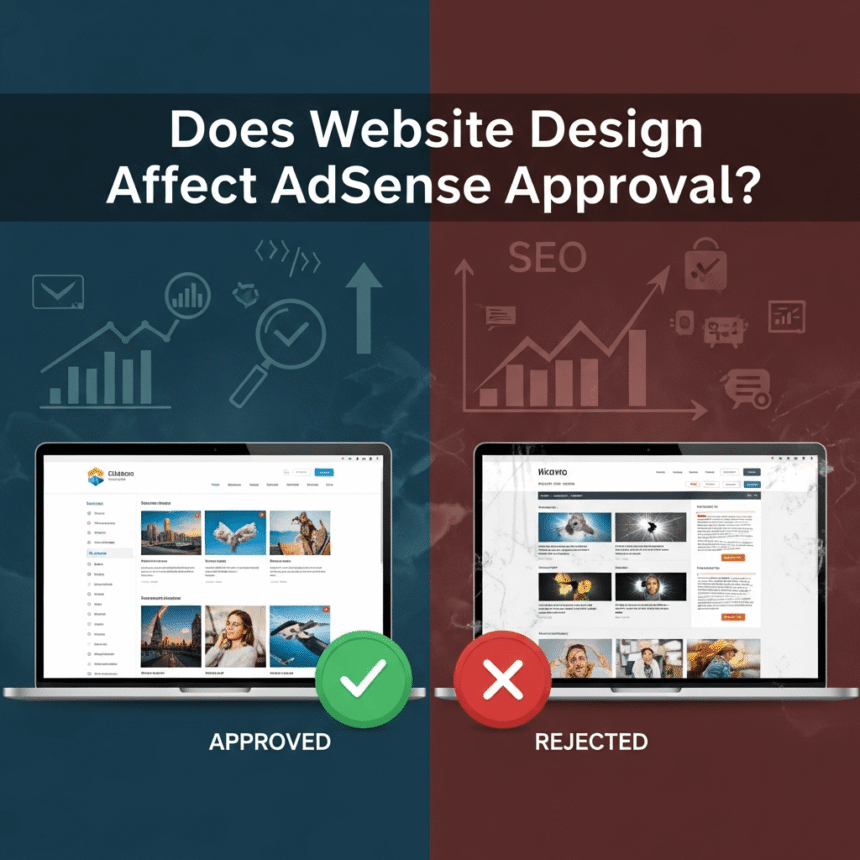

If you are looking to monetize your website, you have likely heard that getting approved by an ad network can be a bit of a challenge. Many bloggers focus entirely on their articles, thinking that content is the only thing that matters. While great writing is essential, your website design plays a massive role in whether or not your application gets accepted.
A messy or confusing website can lead to an immediate rejection. Here is a look at why design matters and what you need to do to prepare your site for a successful review.
First Impressions and Professionalism
When a review team looks at your site, they are looking for professionalism. A website that looks like it was made in 1995 or one that has broken images and overlapping text sends a signal that the site is not being maintained.
A clean, modern design shows that you are serious about your business. You do not need to spend thousands of dollars on a custom developer. Using a well-known, responsive theme is usually enough to meet the standard. The goal is to make the site look “lived-in” and polished.
The Role of User Experience
User experience, often called UX, is a major factor in the approval process. If a visitor cannot figure out how to use your site, they will leave immediately. Reviewers want to see that your site is built for humans, not just for bots.
Key elements of a good user experience include:
- Readability: Use fonts that are easy on the eyes. Ensure there is enough contrast between your text and the background.
- Whitespace: Do not crowd your pages. Give your text and images room to breathe so the reader does not feel overwhelmed.
- Mobile Responsiveness: Your site must look and work perfectly on smartphones. Most web traffic today happens on mobile devices, and a site that breaks on a phone will likely be rejected.
Navigation is Critical
One of the most common reasons for rejection is “Difficult Site Navigation.” If a reviewer cannot find your content easily, they will assume your users can’t either.
Your menu should be clear and located at the top of the page. It should link to your main categories and your most important pages. Avoid using “mystery” icons that people have to click on just to figure out where they go. Clear labels like “Home,” “Blog,” and “Contact” are always better than clever or vague titles.
Necessary Legal and Information Pages
Design is not just about colors and layouts; it is also about the structure of your information. There are certain pages that every professional website must have to be considered trustworthy.
- About Us: This tells the reviewer who is behind the site and what the purpose of the content is.
- Contact Us: This shows that you are a real person or company that can be reached.
- Privacy Policy: This is a legal requirement in many regions and a strict requirement for most ad networks. It explains how you handle visitor data.
Make sure these pages are easily accessible, usually in the footer or the main navigation menu.
Content Layout and Hierarchy
How you display your articles matters just as much as the words themselves. If your homepage is just a long list of 50 full-length articles, it becomes hard to navigate. Instead, use a layout that shows a featured image, a title, and a short snippet or “Read More” button.
Using headings (like H2 and H3 tags) within your posts helps organize your thoughts. It makes your content “scannable,” which is a sign of a high-quality site design.
Summary of Design Requirements
To give your site the best chance of approval, follow this checklist:
- Use a clean, fast-loading, and responsive theme.
- Create a clear navigation menu that works on both desktop and mobile.
- Ensure your text is easy to read with a font size of at least 16px.
- Include all necessary legal pages in your footer.
- Remove any “under construction” pages or broken links.
By focusing on these design elements, you create a professional environment that proves your website is a high-quality platform for advertisers.