

The world of making content is moving faster than ever. If you feel like you just learned how to use one tool and three more have already appeared, you are not alone. In 2026, the focus has shifted from just using AI to write faster to using it to create smarter, more personal, and more varied types of content.
Whether you are a blogger, a small business owner, or a social media creator, staying on top of these trends is the best way to grow your audience. Here are the major AI content creation trends you need to know right now.
1. The Rise of Multimodal Creation
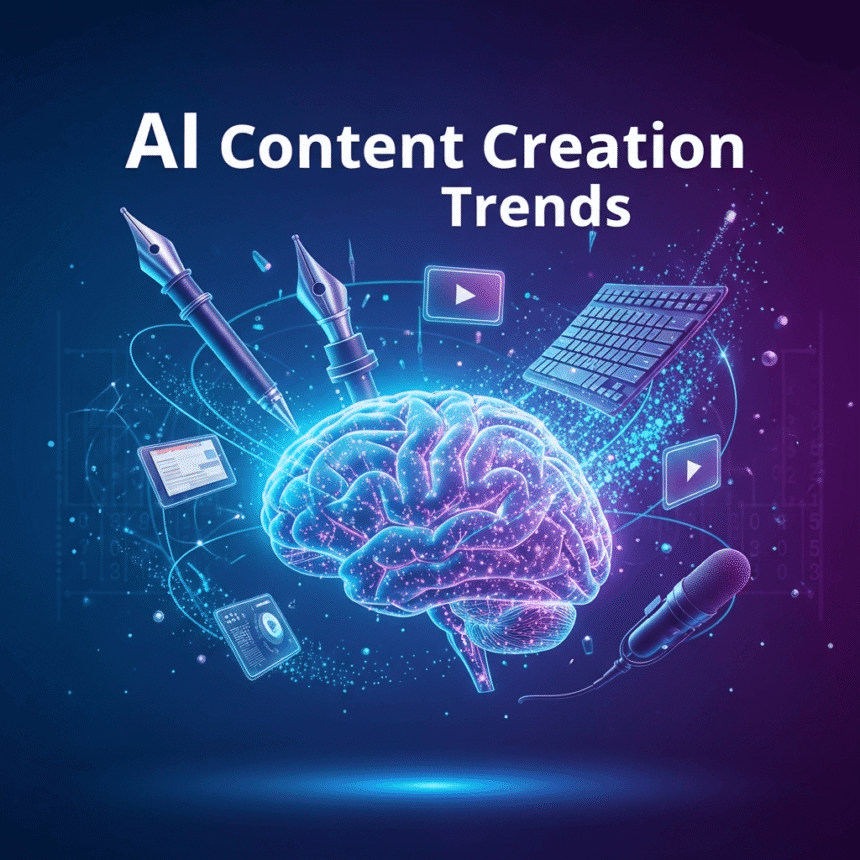
In the past, people used one AI tool for text, another for images, and a completely different one for video. That has changed. Today, the biggest trend is multimodal AI. This means a single tool can understand and create across different formats at once.
For example, you can give an AI a single idea, and it will simultaneously produce:
- A well-structured blog post.
- A set of matching social media graphics.
- A short video script with background music.
This “all-in-one” approach helps creators keep their brand looking and sounding the same across every platform without spending days on manual editing.
2. Hyper-Personalization at Scale
Generic content is no longer enough to get people’s attention. Readers in 2026 expect content that feels like it was written specifically for them. AI is making this possible through hyper-personalization.
AI tools can now look at how your visitors behave and automatically adjust the content they see. Imagine a blog post that changes its examples based on whether the reader is a student or a business executive. This technology allows you to serve thousands of people while making every single person feel like you are speaking directly to their unique needs.
3. AI Agents as Digital Teammates
We have moved past simple chatbots. The new trend is AI Agents. Unlike a basic tool that waits for you to tell it what to do, an AI agent can act like a digital employee.
These agents can:
Monitor your industry for trending topics while you sleep.
Research a complex subject and find real-world data to back up your claims.
Update your old blog posts with fresh information automatically.
Distribute your content to different social media channels at the best time for engagement.
This allows small teams to have the same “output power” as a large marketing agency.
4. Cinematic AI Video for Everyone
Video continues to be the most popular type of content, but it used to be expensive and difficult to make. In 2026, AI video tools have reached a level where they can produce cinematic-quality footage from a simple text prompt.
These tools now offer:
Character Consistency: You can keep the same person or mascot in every video you make, which is great for building a brand.
Realistic Physics: The movements in AI videos now look natural, avoiding the “weird” look of older AI clips.
Integrated Audio: AI can now generate realistic voices and sound effects that perfectly match the action on the screen.
5. The “Human-in-the-Loop” Model
With so much AI-generated content on the internet, people are starting to value the human touch more than ever. The most successful creators are not letting AI do 100% of the work. Instead, they use the “Human-in-the-Loop” strategy.
AI handles the heavy lifting—like the first draft, the research, and the formatting—while the human creator adds:
Personal stories and lived experiences.
Unique opinions and “contrarian” views.
Final fact-checking and emotional depth.
This combination ensures the content is produced quickly but remains high-quality and trustworthy.
6. Moving Toward AI Search Optimization
Search engines are changing. People are now using AI to get direct answers rather than just clicking through a list of links. Because of this, creators are changing how they write.
Instead of just “stuffing” keywords into a post, the trend is to focus on authority and intent. This means writing content that clearly and deeply answers a user’s question. AI tools are now used to predict what questions people will ask next, helping creators stay one step ahead of the search trends.
Why This Matters for You
The goal of these trends is not to replace creativity, but to remove the “boring” parts of the job. By embracing these tools, you can spend less time on formatting and technical details and more time on the big ideas that truly connect with your audience.
The future of content is a partnership between human imagination and AI efficiency. Those who learn to balance the two will be the ones who stand out in a crowded digital world.