

If you are a blogger or a website owner looking to make money from your content, you have likely seen the terms CPC and RPM in your reports. At first, these numbers can be confusing. You might wonder which one is more important or why your earnings change even when your traffic stays the same.
Understanding the difference between these two metrics is the key to growing your income. In this guide, we will break down what they mean in simple English and how they work together to determine your success.
What is CPC?
CPC stands for Cost Per Click.
This is the amount of money you earn every single time a visitor clicks on an ad on your website. Think of it as the “price” of a click.
In the world of online advertising, businesses bid on keywords to show their ads. Some topics, like insurance or legal services, have a very high CPC because those businesses are willing to pay a lot to get a new customer. Other topics might have a lower CPC.
Why CPC Matters
- Direct Income: It tells you exactly how much one action from a user is worth.
- Niche Value: It helps you understand if the topic you are writing about is valuable to advertisers.
- Variation: CPC is never fixed. It can change depending on the advertiser’s budget, the time of year, or even where your visitor is located.
What is RPM?
RPM stands for Revenue Per Mille. “Mille” is the Latin word for a thousand.
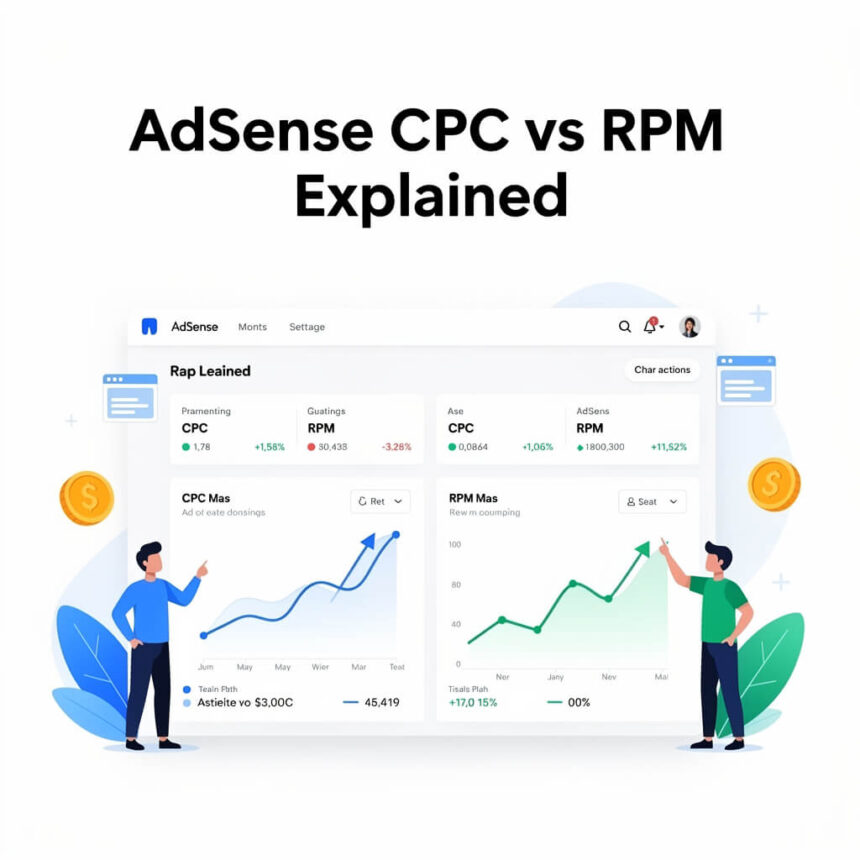
While CPC focuses on a single click, RPM focuses on your total earnings per 1,000 page views. It is a way to see how well your website is performing as a whole.
The formula for RPM is:
(Total Earnings / Number of Page Views) x 1,000
For example, if you earned $10 from 2,000 page views, your RPM would be $5. This means for every 1,000 people who visit your site, you are making $5.
Why RPM Matters
- The Big Picture: It shows you the overall health of your monetization strategy.
- Traffic Quality: A high RPM usually means you have a good mix of high-value ads and visitors who are interested in them.
- Comparison: You can use RPM to compare different pages on your site to see which topics are making you the most money.
The Key Differences Between CPC and RPM
The easiest way to remember the difference is to look at who the metric focuses on.
| Metric | Focus | What it measures |
| CPC | The Individual Action | The money earned from one single click. |
| RPM | The Overall Performance | The money earned for every 1,000 visitors. |
CPC tells you how much an advertiser pays for a click, but RPM tells you how much your traffic is actually worth to you. You could have a very high CPC, but if nobody clicks the ads, your RPM will stay low. On the other hand, you could have a low CPC, but if many people click, your RPM could be quite high.
How to Improve Your Metrics
Now that you know what they are, how do you make them go up? Here are a few simple tips:
To Increase Your CPC:
- Write About Valuable Topics: Research keywords in your niche that advertisers are willing to spend more on.
- Target High-Income Locations: Visitors from countries like the USA, UK, or Canada often attract ads with a higher CPC.
- Produce Quality Content: High-quality, long articles help the system understand your page better, leading to more relevant and higher-paying ads.
To Increase Your RPM:
- Improve Ad Placement: Put your ads where people are likely to see them, such as inside the content or at the top of the page.
- Increase User Engagement: The longer a visitor stays on your site, the more ads they see, which can lead to more clicks and a higher RPM.
- Optimize for Mobile: Make sure your site looks great and loads fast on phones. Most people browse on mobile today, and a slow site will drive them away before they even see an ad.
Final Thoughts
Neither CPC nor RPM is “better” than the other. They are different tools that help you understand your business. CPC helps you see the value of your niche, while RPM helps you see the efficiency of your website.
By keeping an eye on both, you can make smarter decisions about what to write and where to place your ads.