

The digital landscape is more crowded than ever. For website owners and marketers, the challenge isn’t just showing an ad; it’s making sure people actually see it. Traditionally, finding the best spot for an ad involved a lot of “guess and check” work. You would place an ad, wait a month, look at the results, and then move it.
AI has changed that. Today, we can use artificial intelligence to predict exactly where an ad should go before it even goes live. By simulating human behavior, AI helps you skip the guesswork and head straight to the high-performing spots.
The Science of Digital Attention
Humans are predictable. When we land on a website, our eyes usually follow specific patterns. AI models are now trained on millions of these “eye-tracking” data points. They know that a person’s gaze often forms an “F” shape on a page or lingers near high-contrast images.
AI uses a technique called Visual Saliency to map out these patterns.
A saliency map is essentially a weather map for your website’s layout. It uses colors to show where attention will be “hot” (red) and where it will be “cold” (blue). By running your page design through an AI model, you can see which areas naturally grab the most focus. If your ad is in a “blue” zone, it’s practically invisible, no matter how good the design is.
How AI Predicts the Winners
AI doesn’t just look at where a person might look; it looks at the “why” and the “when.” Here are the three main ways AI predicts top-tier ad positions:
1. Simulated Eye-Tracking
Instead of hiring 50 people to sit in a lab and look at your site, AI uses “predictive eye-tracking.” These models can simulate how a visitor will scan your page in the first two seconds. Since most users decide to stay or leave a site in under three seconds, those first few glances are everything. AI tells you if your ad is part of that initial “first look” or if it’s being ignored.
2. Contextual Layout Analysis
AI is great at understanding the relationship between different parts of a page. It knows that an ad placed right next to a “Buy Now” button might perform differently than one placed next to a long block of text. AI analyzes the Cognitive Load of your page. If the page is too busy, the AI predicts that the ad will be lost in the noise. It helps you find the “sweet spot” where the ad is visible but not annoying.
3. Historical Pattern Matching
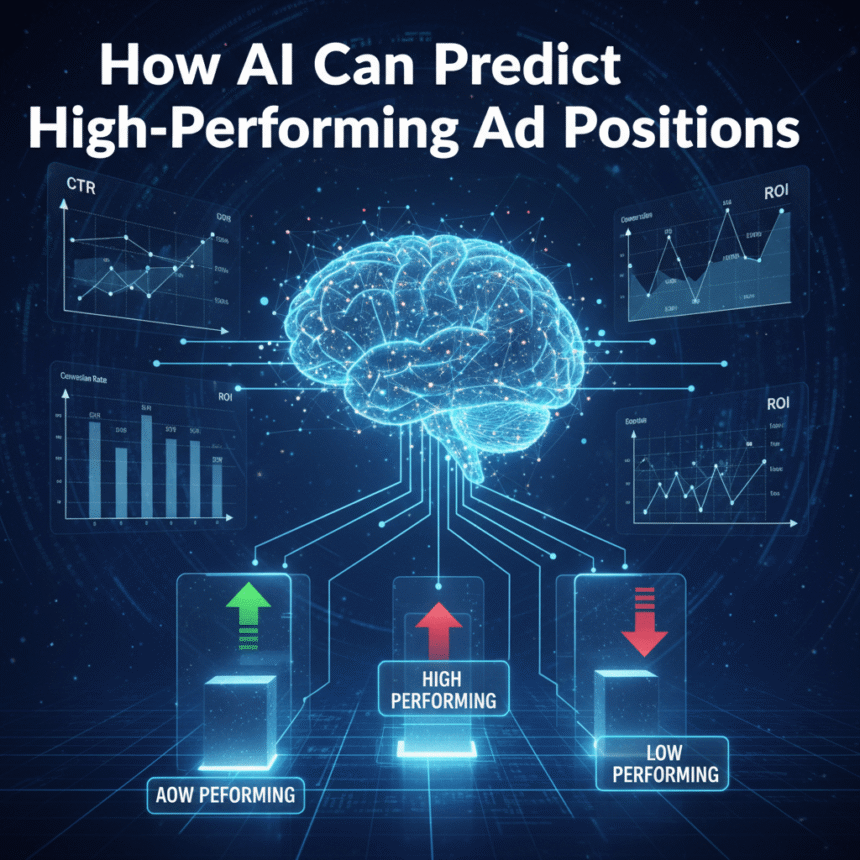
AI models have “read” thousands of successful (and failing) ad campaigns. They can recognize patterns that humans might miss. For example, the AI might find that for your specific audience, ads placed at the end of the second paragraph of an article perform 20% better than ads at the very top. It uses this historical data to give you a “probability score” for every possible ad position on your site.
Why This Matters for Your Site
Using AI to predict ad positions isn’t just about being “high-tech.” It has real-world benefits for your bottom line:
Higher Viewability: You stop wasting space on ads that no one sees.
Better User Experience: By placing ads where they naturally fit the “flow” of the page, you make the site feel less cluttered.
Faster Testing: Instead of waiting weeks for A/B test results, you get instant feedback on where to move your ads.
The Future: Real-Time Optimization
We are moving toward a world where ad positions aren’t static. In the near future, AI will likely adjust ad positions in real-time based on how a specific user is scrolling or moving their mouse. If the AI detects that a user is skimming quickly, it might move the ad to a more prominent “anchor point” to catch their eye.
Predicting high-performing ad positions is no longer a luxury for big corporations. With the AI tools available today, any website owner can look through the eyes of their audience and make data-backed decisions that drive real results.