
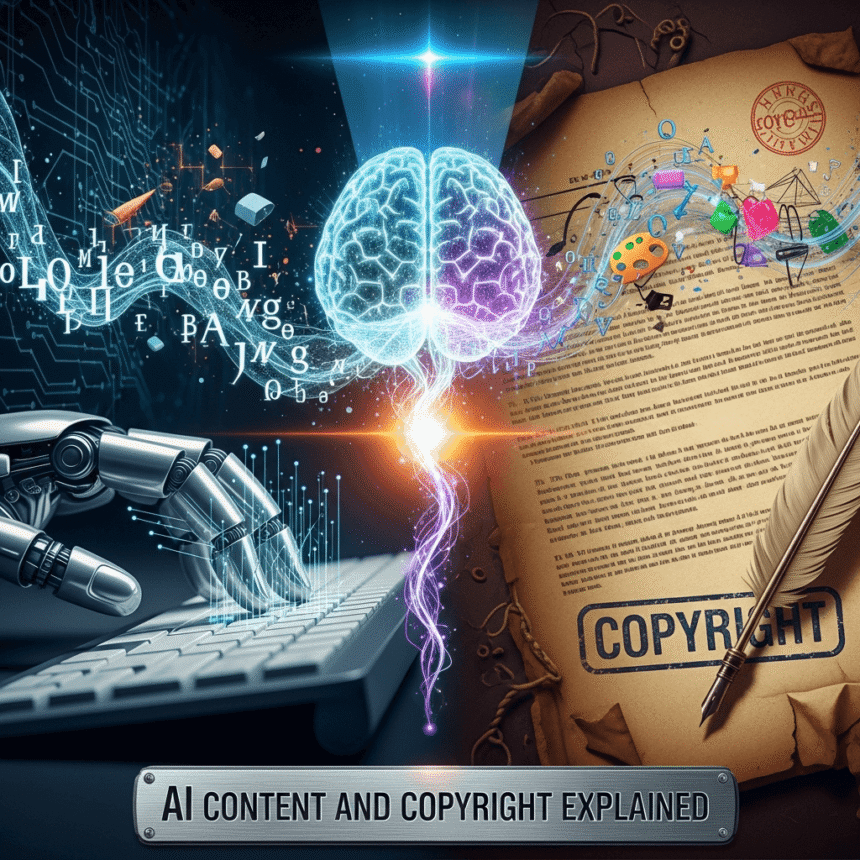

The rise of artificial intelligence has changed how we create. Today, you can generate a 1000 word article or a beautiful digital painting in seconds. But this speed brings up a big question: who actually owns that content?
Understanding the link between AI and copyright is no longer just for lawyers. If you are a blogger, a business owner, or a digital creator, knowing these rules is vital for protecting your work.
The Core Rule: Human Authorship
In most parts of the world, copyright laws are built on one main idea: human authorship. For a work to be protected by copyright, it must be created by a human being.
Currently, the legal systems in the US, the UK, and the EU do not recognize AI as an “author.” This means that if an AI creates something entirely on its own, that content usually cannot be copyrighted. It often falls into the “public domain,” meaning anyone can use it without asking for permission.
What About Your Prompts?
You might think that because you wrote a very detailed prompt, you are the author. However, copyright offices generally disagree. They view a prompt as an “idea” or an “instruction” rather than the act of creation itself.
Think of it like commissioning a human painter. You can tell the painter exactly what you want (the prompt), but the painter is the one who makes the creative choices that result in the art. In the eyes of the law, the AI is making those creative choices, not the person typing the prompt.
How to Gain Copyright Protection
While pure AI output is hard to protect, you can still own the rights to your work if you are heavily involved in the process. Here are the three main ways creators are securing their rights in 2026:
Substantial Editing: If you take an AI draft and rewrite 50% or 60% of it, adding your own stories, facts, and unique voice, you can likely copyright the final version.
Creative Arrangement: If you create a graphic novel where the images are AI-made but you wrote the story, arranged the panels, and chose the layout, your specific arrangement and text are protected.
Human-in-the-Loop: Using AI only for the “rough draft” or for brainstorming. The more human “creative control” you show, the stronger your legal claim becomes.
New Rules and Transparency
Starting in 2026, new regulations like the EU AI Act have introduced stricter rules for transparency. These laws require that:
AI Disclosure: Platforms and creators must clearly label content that was generated or heavily manipulated by AI.
Training Data Rights: AI companies must be more transparent about the data they use to train their models, giving original creators more power to “opt-out” of having their work used for training.
Summary Table: Who Owns What?
Why This Matters for Your Website
If your website relies entirely on unedited AI content, you may have no legal way to stop someone else from copying your articles and posting them elsewhere. To build a valuable brand, you should always add a “human touch” to your AI-assisted content. This ensures you have the legal right to protect your work and provides better value to your readers.
The legal world is still shifting, so it is a good idea to keep a record of how you used AI in your creative process.