


Have you ever wondered how Google decides which website appears at the very top of your search results? It can feel like magic, but it is actually a very organized process. Google uses a complex system to sort through billions of pages in a fraction of a second to find the one that helps you most.
To make it easy to understand, think of Google as the world’s most advanced librarian. Here is a simple breakdown of how that librarian works in 2026.
The Three Steps: Crawling, Indexing, and Ranking
Before a website can even show up on your screen, Google has to know it exists. This happens in three main stages:
Crawling: Google sends out automated programs called “crawlers” or “bots.” These bots follow links from one page to another, discoverying new content across the web.
Indexing: Once a page is found, Google reads it to understand what it is about. It then stores this information in a giant database called the Search Index.
Ranking: When you type something into the search bar, Google looks through its index and picks the best pages to show you.
What Makes a Website Rank Higher?
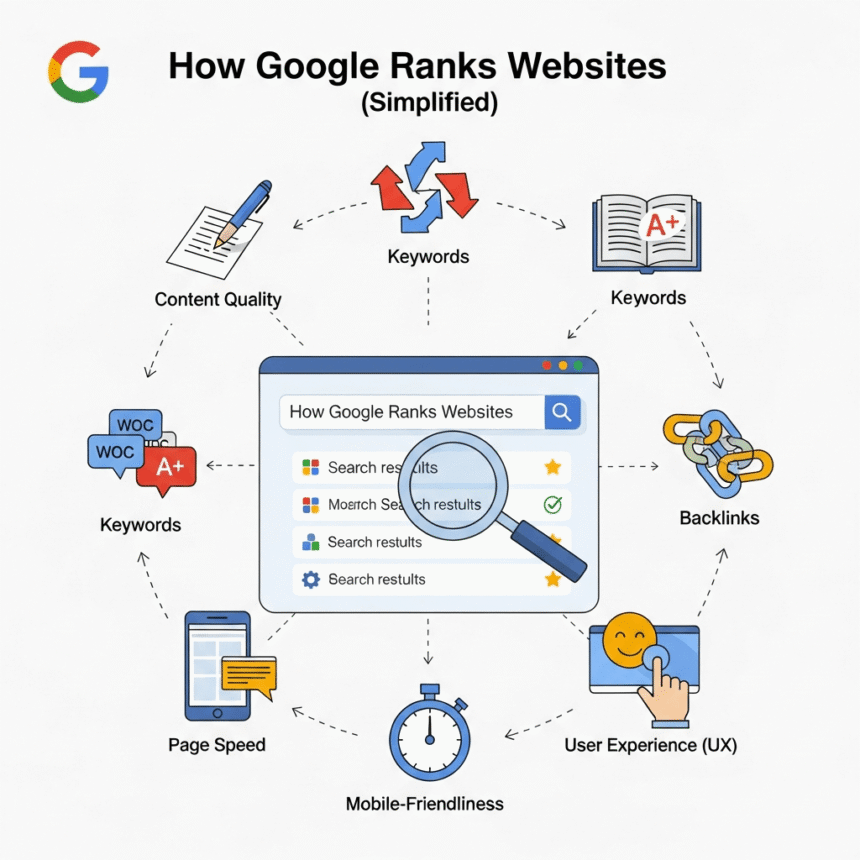
Google looks at hundreds of signals to decide which page is number one. However, most of them fall into a few simple categories that you can focus on.
1. Understanding Your “Intent”
The most important thing Google cares about is Search Intent. This means Google tries to guess why you are searching.
If you search for “how to bake bread,” Google looks for a tutorial.
If you search for “buy sourdough bread,” Google looks for a store.If a website matches your intent perfectly, it has a much better chance of ranking.
2. The E-E-A-T Rule
Google uses a special framework to judge the quality of a website. It is called E-E-A-T, which stands for:
Experience: Does the writer have first hand experience with the topic?
Expertise: Is the author a professional or well-known in this field?
Authoritativeness: Is the website a go-to source for this information?
Trustworthiness: Is the site secure, honest, and accurate?
3. Freshness and Accuracy
For many topics, like news or technology, Google prefers “fresh” content. If an article was written five years ago and hasn’t been updated, Google might rank a newer, more accurate article higher.
4. User Experience (The “Feel” of the Site)
Google wants you to have a good time visiting a website. If a site is slow, hard to read on a phone, or has buttons that don’t work, Google will likely push it down in the results. A fast, mobile-friendly site is a huge plus.
Why Do Rankings Change?
You might notice that a website is at the top today but moves down tomorrow. This happens because Google is constantly learning. It releases “Algorithm Updates” to improve its results. These updates are meant to reward helpful, human-first content and filter out low-quality or “spammy” pages.
Summary Checklist for Success
If you want your own website to rank well, focus on these simple goals:
Write for people, not robots: Make your content easy to read and truly helpful.
Be the expert: Share your real life experiences and knowledge.
Keep it fast: Ensure your website loads quickly on both computers and phones.
Stay updated: Regularly check your old posts to make sure the facts are still correct.
Ranking on Google is not about “tricking” a computer. It is about being the most helpful answer on the internet for the person asking the question.