
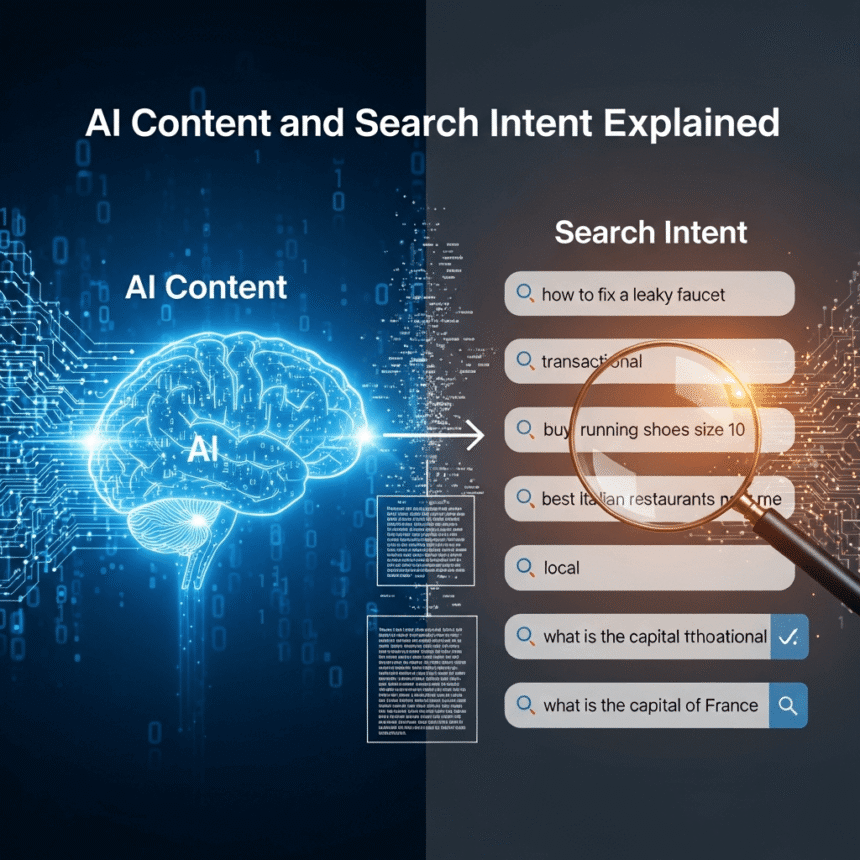

The world of search is changing faster than ever. Not long ago, ranking on the first page was all about choosing the right keywords and repeating them enough times. Today, search engines have become much smarter. With the rise of artificial intelligence, search engines no longer just look for words that match; they look for the meaning behind those words.
If you want your blog or website to succeed in 2026, you need to understand two things: how AI creates content and how search intent dictates what people actually want to see.
What is Search Intent?
Search intent is the “why” behind a search. When someone types a phrase into a search bar, they have a specific goal. They aren’t just looking for a website; they are looking for an answer, a product, or a specific location.
There are four main types of search intent that you should know:
- Informational: The user wants to learn something. (Example: “How to fix a leaky faucet”)
- Navigational: The user is looking for a specific website. (Example: “Facebook login”)
- Commercial: The user is researching before making a purchase. (Example: “Best noise-canceling headphones 2026”)
- Transactional: The user is ready to buy right now. (Example: “Buy organic coffee beans online”)
If your content does not match the user’s intent, they will leave your site immediately. AI search engines track this behavior. If people leave quickly, the AI learns that your page isn’t helpful, and your rankings will drop.
How AI Understands What Users Want
In the past, search engines were like a simple filing cabinet. You searched for a label, and it gave you the folder. Now, AI models like Google’s latest updates and various AI assistants act more like a librarian who has read every book in the building.
AI uses Natural Language Processing (NLP) to understand context. It can tell the difference between a user who wants to buy a “bat” for baseball and a user who wants to learn about the “bat” that flies at night. It looks at the words around the search term and even the user’s previous search history to provide the most relevant result.
The Role of AI in Content Creation
Many creators are now using AI to help write their posts. While AI can generate text quickly, there is a big difference between “AI-generated” and “AI-optimized” content.
- AI-Generated Content: This is content written entirely by a machine. Often, it can feel a bit robotic or generic. If it doesn’t offer a unique perspective or solve a specific problem, search engines might see it as “thin” or “low-quality.”
- AI-Optimized Content: This is where a human uses AI as a tool to research, outline, and improve their writing. The human provides the “soul” and the “experience,” while the AI helps ensure the content covers all the topics the user is looking for.
Balancing AI and Intent for Better Results
To attract more visitors, your content needs to be the “best answer” for the user’s intent. Here is how to make that happen using AI:
Use AI for Research, Not Just Writing
Instead of asking AI to “write a blog post,” ask it to “identify the most common questions people have about [Topic].” This helps you find the specific sub-topics that satisfy informational intent.
Structure for Skimmability
AI search engines love structure. Use clear headings, bullet points, and short paragraphs. This makes it easier for both the AI and the human reader to find the answer they need quickly.
Focus on E-E-A-T
Search engines prioritize content that shows Experience, Expertise, Authoritativeness, and Trustworthiness. AI cannot truly “experience” things. By adding your personal stories, original photos, or expert opinions, you give your content a human touch that AI-only content lacks.
Why Quality Wins Over Quantity
In 2026, the internet is flooded with content. Because AI makes it so easy to publish, there is a lot of noise. To stand out, you don’t need to post every day; you need to post content that is better than everything else available.
When your content perfectly matches search intent, the AI sees that users are spending time on your page and clicking your links. This sends a “trust signal” to the search engine, telling it that your site is a high-quality source.
Conclusion
Understanding the link between AI content and search intent is the secret to modern SEO. By focusing on why people are searching and using AI to make your answers clearer and more comprehensive, you can stay ahead of the curve.